fun semester. Trinity + Double math :sleepy:
primarily I did this because of the new SU rules. Starting my year, we have 20 credits to SU for Y1 and Y2, then 12 to carry to Y3 and Y4. But, SEP is based on pre-SU GPA. The earliest you can apply for SEP is at the start of Y2. Therefore, compress all the non-fluff mods with predictable grades (looking at you, IS1108) into Y1.
MA1521 — Calculus for Computing
| Component | Weight | Dist. |
|---|---|---|
| Weekly Homework (×10) | 1% each | Free |
| Canvas Quiz (×4) | 8% each | Free |
| Final | 58% | ? |
Homework can be typed or written. Written is more annoying to submit, but gives you better practice for the final. I ended up taking a day or so just practicing writing for the final anyways, since my hands had atrophied by that point. This may seem trivial, but this involves having a good sense of how much space you need, how you want to lay out your statements, and of course, legibility.
The final was a bit of a time crunch, with one or two tougher questions. I managed to finish most of the paper, but did leave half a question blank. Combined with (the guaranteed) careless mistakes of the questions I did do, I still got an A.
My sense is that you either need to do most questions perfectly, or all questions decently well to get an A. If you want an A+, you need to do almost all questions perfectly.
MA1522 — Linear Algebra for Computing
| Component | Weight | Dist. |
|---|---|---|
| Problem Solving Sessions | 10% | Free |
| Lecture Quiz (Canvas) | 15% | Free |
| Homework Assignments (×3) | 5% each | Free |
| Midterm | 20% | YIKES |
| Final | 40% | ? |
Each week there would be two 2h lectures. The second lecture in each week is known as the problem solving session. Basically, we’re given a problem set at the start of the session, and need to submit (digitally) by the end. Grading is by attempt. Profs would go through each question, so if you got stuck you just needed to wait until he got to that question, and you could copy it down. Interesting, but unfortunately not well calibrated. Even with the literal answer key being projected, many people still needed time to catch up.
The midterm was 15 MRQs on Examplify. No negative marking. Each correct selection gives the respective fraction of marks. You’re also indirectly told how many correct options there are, since it wouldn’t let you over-select (eg, if there are only three correct options out of the five, you can’t select more than three)
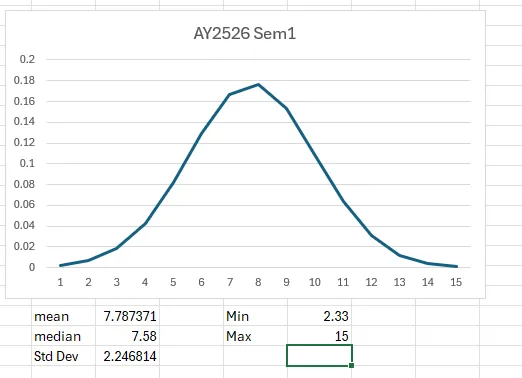
Despite all this help, the midterm was still considered the hardest in recent years, and the mean and median were right at 50%. (iirc it’s Prof Lo Chi-Heng’s first time setting a paper)
I got 12.5 on the midterm, placing me at around the 90th percentile. Final wasn’t returned, but cross referencing the answer key, I only got one or two questions wrong. final grade: A+.
CS2030S — Programming Methodology II
| Component | Weight | Dist. |
|---|---|---|
| Self Quiz (Best 10 of 12) | 0.5% each | Free |
| Lab (Best 5 of 7) | 1% each | Free |
| Practical Exams (×2) | 20% each | mmm |
| Midterm | 20% | okay |
| Final | 30% | yikes |
Labs are highly predictive of your practical exam performance. If you find yourself unable to finish the labs in time, you need to start practicing more. There is weekly homework for practice which are graded with feedback, and doesn’t affect your grade. I highly recommend doing these if you have the time, and especially if you’re struggling with labs. As obvious as it is, you must practice to do well on the practical exam!

Exams are more theory focused. The midterm is mainly focused on OOP (especially polymorphism and specific Java details), while the final is focused on functional programming concepts. You will learn about Monads, though not in the famous “a monad is a monoid in the category of endofunctors” way.
Random anecdote, I had a few friends who were extremely confident in the final, and didn’t prepare a cheatsheet. So, I dared them to bring in just “a monad is a monoid in the category of endofunctors” as their cheatsheets (of course, I printed it for them). They both got A+, and one got the top student award. maybe this is the meta?
CS2040S — Data Structures and Algorithms
| Component | Weight | Dist. |
|---|---|---|
| Kattis Problem Set 0 | 1% | Free |
| Kattis PS1–PS6 | 2% each | Free |
| VisuAlgo Quiz (×3) | 4% each | Free |
| Tutorial Participation | 5% | okay |
| Midterm | 10% | okay |
| Final | 60% | mmm |
I believe I got full marks for the problem sets, participation, and midterms. I lost ~1% to the quizzes, and got 52/60 for the final (-8%). Overall A+ (and top student :o)
If you’re not familiar with Kattis, it’s basically Leetcode for schools.
VisuAlgo is by Prof Halim himself. It’s primarily an algorithm visualization tool. / textbook. We had a flipped classroom arrangement. You’re expected to click through VisuAlgo before class, then come for lectures and get the DLC content.
But it also has a quiz function! There were three 15 minute quizzes throughout the semester. The questions are grindable, as they’re a fixed format available in a the practice function. (though, prof would sometimes add one or two new questions.)
Tut participation was graded rather funnily. iirc, per class of 15-20, TAs were only allowed to give the full 5% to a handful of students. The remaining students only got between 0 to 3%.
Midterm: In previous years, there was always a question asking you to write down your TA’s name. Unfortunately that didn’t appear this year. but i still remember my TA’s name i guess (hi wei jian). tip: prof halim’s favourite number is 7. I sat in seat 77 for the midterm, and FC’d it. coincidence? yes.
Final: In past years, 2040S run by Prof Halim would include a practical test (I believe on Kattis). It was removed this year, with the 20% it would be worth added into the final, thus making it a net 60%.
CS2100 — Computer Organisation
hate this mod >:(